Bacteria for sewerage
27.10.2021Bio-bacteria for sewage
28.10.2021
Harvest without pesticides
During the Soviet era, collective farm agricultural lands were huge experimental fields, where various theories of agriculture were practiced.
Is it good or bad?
Of course, it is good – because without practical confirmation, science, and agronomy, in particular, can not move forward.
Due to this, the whole system of agriculture was verified. That’s just … “It was smooth on paper, but they forgot about the ravines” – more precisely, about the “human factor”.
In principle, each of the proposed systems was scientifically sound and very useful for specific regions. Consequently, they had to be applied taking into account soil and climatic conditions, the method of scientific approach, rather than directives “from above”. It is natural that such thoughtless experimentation has led to a sharp decline in soil fertility. Moreover, heavy tillage machines strongly compact the soil, which also leads to poor fertility and increases soil erosion. In addition, the long-term use of mineral fertilizers in large quantities, instead of benefits, has led to a significant destruction of the humus coating. A vicious circle has formed: the deterioration of fertility leads to lower yields and requires the introduction of increasing doses of mineral fertilizers. And this leads to an even greater decrease in fertility and forces to increase the dose of chemicals again.
Our offers
In Ukraine, the land is in private ownership for more than a year. But it was this long-suffering land that people got. We will not now talk about the harm of soil contamination with heavy metals and other toxic chemical elements – this has been said many times and in detail. We will try to find a way out of the ring.
Is it possible to obtain high-quality environmentally friendly products while maintaining soil fertility? We believe that this result is quite achievable, provided that certain, long-established, and scientifically proven methods.
So, the first point is the scientific approach
Before you pick up a shovel, we advise you to pick up a pencil and paper. Make a list of the vegetables you would like to get and in what quantity. This will allow you to calculate how many seeds you need to buy, how many seedling bushes or seedlings, which varieties. Which, in turn, will avoid chaotic shopping and save money.
The second point is the scientific approach
Make a plan for your land. Estimate how many beds you will need. Analyze which crops can be planted side by side and which are undesirable. Each of the vegetable crops has its own ripening time.
Early crops (lettuce, radish, kohlrabi, spinach) ripen in a few weeks and make room for basic vegetables and fruits.
Late crops (winter onions, endive, and winter-hardy spinach) are planted at the end of the season, in the vacated place. And there are also intermediate crops that are planted along with the main ones. They have a short ripening period and you will have time to harvest just at the time when the main crops will grow and they will need more space. Every gardener has their favorites among vegetables, but if you want the land on the site is not empty for free, you have to think about the rational use of their beds.
The third point is the scientific approach
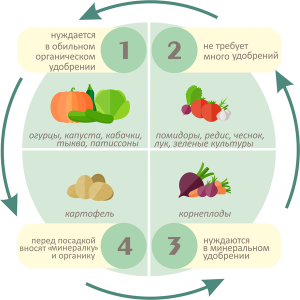
Be sure to make a crop rotation plan. Different plants need different trace elements for growth and maturation. For example, leafy crops (lettuce, celery, cabbage) need the most nitrogen.
Fruit crops (cucumber, tomato, pumpkin, beans) require potassium.
Root crops (potatoes, carrots, beets) need phosphorus.
So, after the harvest, the soil in this bed will be significantly depleted of a particular trace element, and next year this crop will not give a great harvest. In addition, while the crop is maturing, weeds and pathogens of this family of plants accumulate in the soil. In order not to give them the opportunity to harm the next year, it is necessary to change the landing sites, ie to carry out crop rotation.
Study the crop rotation tables in advance and sign the beds on the plot plan.
Properly composed crop rotation will allow you to:
significantly increase soil fertility without chemicals;
help fight pests and weeds;
prevent plant diseases;
significantly reduce wind and water erosion of the soil.
The fourth point is the scientific approach
When crop rotation only vegetable plants still have a disadvantage. After harvesting, few roots remain in the soil, and the tops are not recommended to plow into the ground, so as not to bring pests. Constant loosening of the soil disturbs the water and air balance interfere with the vital microflora. The way out is obvious: you need to lay a compost pile on the site (if possible 2-3). (Didn’t you forget? – we’re still making a site plan.)
The biodestructor for composting “KALIUS” will become your irreplaceable assistant for the fast preparation of compost.
Bacteria for the soil contained in this biological product, not only contribute to the rapid preparation of compost but also translate trace elements into a soluble state, for maximum absorption by plants.
It is established that the best source of soil saturation with phosphorus, nitrogen, and potassium, necessary for further plant growth – are the remains of the plants themselves. When plowing stubble in the soil returns 12-15 kg of nitrogen, 7-8 kg of phosphorus, 24-30 kg of potassium per hectare. However, the complete decomposition of plant residues will occur in 3-5 years, and during this time the soil will accumulate and pathogenic microflora. And that’s where people come to the aid of biologicals for the garden.
Beneficial bacteria and microorganisms are grown in laboratories for compost not only significantly accelerate the process of decay of residues, but also at the same time destroy harmful microbes and weed seeds in the compost.
Biologicals based on colonies of specially grown bacteria for the soil not only protect plants from a range of diseases but also increase soil fertility, improve plant development, which leads to increased yields. And most importantly – this method of fertilization allows you to collect an environmentally friendly crop.
Organic fertilizers, with the help of microorganisms for compost, will allow you not only to increase crop yields, but also significantly reduce energy and resource consumption, and at the same time – significantly increase soil fertility.
Item five – a scientific approach
Infections, viruses, and even epidemics are common not only to humans but also to plants. The above methods can significantly reduce the influx of pathogens, but completely rid the plants of pests and diseases, which they can not. Get upset early. In nature, everything is balanced – if she invented harmful microorganisms, she also created beneficial bacteria that can resist them. It is on this basis that modern biological products are created to protect plants from diseases and restore soil fertility.
Biofungicide Effect is a universal biological product designed for the treatment of gardens, vineyards, and orchards for the prevention and treatment of fungal and bacterial plant diseases. At the same time serves for nitrogen and phosphorus fertilization of plants. The drug is completely safe for plants and humans. The improvement of plant development gives a yield increase of up to 30%.
Among the biological products for the garden should also pay attention to the insecticide “Kaputt”, which not only protects plants from disease, but also get rid of herbivorous mites, Colorado potato beetle, scale larvae, and pollinators, open-seated aphids, greenhouse whiteflies, thrips, and other pests. Once in the intestine or on the surface of the parasite, the biological product affects the nervous system of pests, causing paralysis and then the death of insects. At the same time, it is absolutely safe for the person, any warm-blooded animals, bees, or earthworms.
Did everyone plan?
Have you purchased the necessary biological products and planting material?
Well, now you can for a shovel. We will not claim that you will easily and easily spend time in the country. But we guarantee that you will definitely have a reason to brag to the skeptics about the harvest.